
Tested for rigorous industrial safety standards, high-impact resistance, and operational efficiency

As Mexico solidifies its position as the premier nearshoring destination for North American manufacturing and logistics, the speed and density of material handling operations across regional industrial corridors have scaled exponentially. Industrial hubs in Monterrey (Nuevo León), Ciudad Juárez (Chihuahua), Tijuana (Baja California), Querétaro, and the Greater Mexico City Metropolitan Area (Edomex) are experiencing record forklift movement, automated guided vehicle (AGV) deployments, and 24/7 loading dock activity.
Loading docks represent the most dynamic—and hazardous—zones in any warehouse or manufacturing facility. According to occupational health and safety statistics, over 25% of all industrial accidents occur in or around loading bay doors, driven by forklift drop-offs, trailer creep, and staging area collisions. Deploying CE certified dock safety barriers is no longer merely a precautionary measure; it is a critical engineering requirement to safeguard personnel, protect structural assets, and meet international supply chain audit standards under T-MEC / USMCA frameworks.
While Mexican facilities operate primarily under the regulatory oversight of the Secretaría del Trabajo y Previsión Social (STPS)—specifically standards NOM-001-STPS-2008 (Workplace Building & Safety Conditions) and NOM-006-STPS-2014 (Material Handling Safety)—multinational industrial plants require internationally harmonized engineering validation. CE Certification under European Standards (EN 1090-1 / EN 15512 structural execution) guarantees that protective dock barriers have undergone rigorous finite element analysis (FEA) and real-world dynamic impact testing.
For plant engineering directors and EHS (Environmental Health & Safety) managers in Mexico, specifying CE certified dock safety barriers ensures:
Selecting the optimal physical protection barrier based on dock impact energy, floor space, and operational frequency
| Barrier System Type | Impact Rating (Joules) | Core Material & Finish | Primary Application Area | STPS / CE Compliance Alignment |
|---|---|---|---|---|
| Heavy-Duty Tubular Dock Guards | 35,000 J – 50,000 J+ | Q355B Heavy Structural Steel / Epoxy Powder Coating (RAL 1023) | Loading Bay Doors, Overhead Door Tracks, Pit Edges | CE EN 1090, NOM-001-STPS-2008 Sec. 7 |
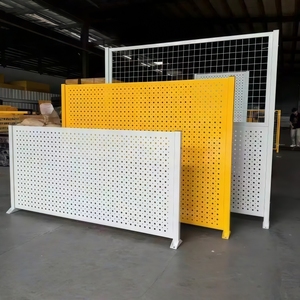
| Modular Perforated Safety Fences | 15,000 J – 25,000 J | Perforated Sheet Steel + Reinforced Frame / Galvanized & Powder Coated | Perimeter Security, Robot Work Cells, Pedestrian Aisle Separation | CE Machinery Directive 2006/42/EC, ISO 14120 |
| Flexible Polymer Impact Barriers | 20,000 J – 40,000 J | High-Density Elastomeric Polymer / UV-Resistant Yellow | High-Traffic Main Aisles, AGV Routes, Cold Storage Docks | CE Structural Compliance, OSHA 1910.28 |
| Surface-Mounted Column Guards | 25,000 J – 38,000 J | Formed Steel Plate + Heavy Anchor Flanges / Traffic Yellow Coating | Building Columns, Racking Uprights, Dock Ramp Entry Points | FEM 10.2.02, NOM-006-STPS-2014 |
Tailored physical security and impact protection configured for distinct regional operational demands
In high-throughput border maquiladoras, dock doors experience continuous trailer docking and rapid cross-docking operations. Our CE certified dock barriers are engineered with spring-assisted hinged gates and high-visibility yellow powder coating, shielding dock door tracks from off-angle forklift strikes during fast-paced loading cycles.
Tier-1 automotive plants in Saltillo, Ramos Arizpe, Silao, and Querétaro handle heavy stamping dies, engine blocks, and automated sub-assemblies. Heavy-duty dual-rail steel barriers safeguard staging zones, sub-assembly cells, and internal battery charging stations against heavy material handling equipment impact.
Mega-fulfillment centers servicing CMX consumer demand require strict segregation between high-speed material handling equipment and pedestrian order pickers. Perforated metal safety fences and dock entrance gate barriers provide physical security while maintaining 85% line-of-sight visual clearance.
Global corporations relocating manufacturing lines from Asia to Mexico are subjected to stringent corporate safety audits. Parent companies require Mexican facilities to mirror US and European plant safety infrastructure. Implementing CE certified safety barriers ensures immediate pass rates during international risk management and insurance underwriting inspections (e.g., FM Global standards).
Modern distribution centers in Mexico are rapidly replacing traditional internal combustion forklifts with lithium-ion powered electric trucks. Electric forklifts carry significantly heavier counterweights concentrated at lower centers of gravity. While operating at similar speeds, their total kinetic energy during an impact is up to 30% higher. Legacy lightweight guardrails are no longer sufficient; plant engineers must specify continuous steel impact barriers with reinforced floor anchor plates.
As advanced logistics parks in Nuevo León and Guanajuato integrate Autonomous Mobile Robots (AMRs), physical dock barriers serve a dual purpose: stopping human-driven equipment and acting as physical reflectors for LiDAR and vision-based navigation systems. Custom perforated metal fences prevent optical interference while physically sealing off hazard zones.
End-to-end engineering control, custom CAD design, and direct container delivery to Mexican ports & border hubs
Unlike trading intermediaries, our manufacturing infrastructure controls every step of production. From automatic laser tube cutting, cold roll-forming, and robotic welding to automated multi-stage washing and electrostatic powder coating, we guarantee dimensional tolerances down to ±0.5mm.
This vertical integration allows us to customize barrier heights, rail lengths, and base plate mounting patterns specifically for Mexican facility floor specifications (including post-tensioned concrete slabs).
We provide full export-ready knocked-down packaging (KD packing) protected by rust-inhibiting films and wooden crates. Cargo is optimized for ocean container delivery to Manzanillo, Veracruz, and Lázaro Cárdenas, or streamlined overland transit via US-Mexico border crossing points at Laredo or Hidalgo.
Complete documentation packages—including CE Certificates of Conformity, Mill Test Reports (MTR), Material Data Sheets (MSDS), and CAD installation guides—are supplied with every shipment.
Need custom dock safety barriers, mezzanine floor protection, or heavy-duty storage racking? Send us your CAD drawings or site dimensions for a detailed engineering proposal within 24 hours.
Send an InquiryEssential answers regarding compliance, impact resistance, custom fabrication, and delivery logistics
CE certified barriers meet and exceed Mexican official standards NOM-001-STPS-2008 (which mandates physical barriers for drop-off edges, physical aisle marking, and structural safety) and NOM-006-STPS-2014 (handling and storage of materials). CE certification provides formal structural engineering proof, finite element analysis, and material traceability, ensuring your facility fully complies during STPS workplace audits and international corporate safety reviews.
For standard 3-ton to 5-ton forklifts operating at typical loading dock speeds (around 8 km/h), safety barriers should have a minimum impact rating of 30,000 to 50,000 Joules. For areas handling heavy electric forklifts or high-speed AGVs, heavy-duty structural steel barriers with thick-wall posts and 20mm floor anchor plates are recommended to absorb maximum kinetic energy without structural failure.
Yes. Every industrial plant layout has unique constraints such as post-tensioned concrete slab depths, dock leveler clearances, or conduit obstructions. Our engineering team prepares custom CAD drawings detailing barrier heights, rail lengths, post spacing, and specialized base plate hole patterns prior to fabrication.
For high-humidity or coastal locations like Veracruz, Tampico, or coastal Quintana Roo, we recommend a dual-layer surface treatment: a hot-dip galvanized (HDG) base coat followed by an architectural-grade electrostatic polyester powder coating in high-visibility Safety Yellow (RAL 1023). This combination delivers superior corrosion resistance against salt spray, chemical exposure, and humidity.
Standard fabrication lead time is 15 to 20 business days depending on project scale and custom specifications. Sea freight shipping to major ports (Manzanillo or Veracruz) typically takes 22 to 30 days, while overland truck freight to northern border hubs (Laredo/Monterrey) is coordinated efficiently with export-grade protective packaging.
Yes. All dock safety barrier shipments include heavy-duty mechanical expansion bolts or chemical concrete anchors engineered specifically for industrial floor slabs, along with rubber shock-absorbing pads, alignment shims, and step-by-step CAD installation manuals.
We supply a complete documentation binder with every project, including Commercial Invoices, Packing Lists with HS Code classifications, Bills of Lading, CE Certificate of Conformity, ISO 9001/14001 Quality System Certificates, Mill Test Reports (MTR) confirming steel chemical composition, and step-by-step assembly schematics.
Partner with an established manufacturer committed to international engineering standards, CE certified safety barriers, and tailored solutions for Mexico's expanding manufacturing industry.
Send an Inquiry