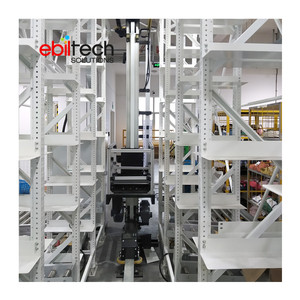
Precision-formed structural storage components, dynamic gravity feed conveyors, robotic storage cabinets, and safety partitions fabricated from certified Q235B/Q355B cold-rolled steel coils.
Years of Direct Engineering, Precision Roll Forming & Global Export Experience
Metric Tons Annual Heavy Cold-Formed High-Tensile Steel Fabrication Capacity
Destination Countries Served with Knock-Down Export Optimization
FEA Structural Calculation & Seismic Integrity Compliance (FEM / RMI / AS4084)
In modern logistics infrastructure, a storage system is not merely passive shelving; it is a critical, load-bearing mechanical asset that directly governs warehouse throughput, operator occupational safety, and asset longevity. As China’s top warehouse storage systems supplier and exporter, our engineering and manufacturing ecosystem eliminates intermediary markups and production variances by controlling every phase of production in-house. We source certified hot-rolled structural steel coils exclusively from premier state-owned mills, converting prime Q235B, Q355B, and high-yield alloys into high-precision upright profiles, box beams, and galvanized structural decks.
Our facility houses 18 automated continuous CNC roll-forming lines. Utilizing up to 24 rolling passes, cold internal stress is methodically eliminated, guaranteeing precise web and flange angles with profile straightness deviation lower than 1/1000 over 12-meter continuous column lengths.
Columns feature automatic continuous punching with specialized multi-directional pitch indexing (50mm or 75mm increments). Die tolerances are preserved within ±0.1mm, ensuring instant beam connector engagement and unyielding mechanical interlock across multi-tier uprights.
Components undergo an automated 7-stage pre-treatment wash cycle (degreasing, phosphating, deionized rinsing) followed by thermosetting epoxy-polyester powder application cured at 200°C. Delivers superior salt-spray resistance, zero VOC off-gassing, and rugged abrasion durability.
Consult this data matrix to evaluate volumetric density, SKU selectivity, and automated crane synergy for optimal capital expenditure (CapEx) ROI.
| Storage Racking System | Volumetric Density | SKU Selectivity | Floor Area Utilization | Primary Handling Equipment | Structural Engineering Benchmark |
|---|---|---|---|---|---|
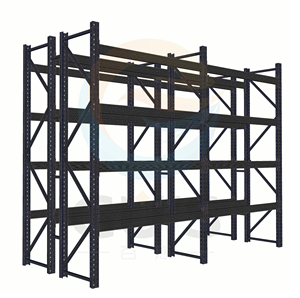
| Selective Pallet Racking | Moderate (40%) | 100% Direct Immediate Access | 35% – 45% Floor Area | Counterbalance, Reach Trucks | FEM 10.2.02 / ANSI MH16.1 |
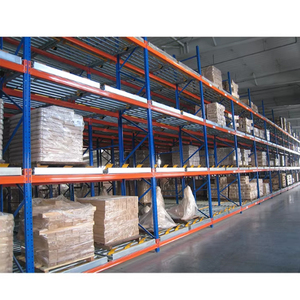
| FIFO Pallet Roller Flow Rack | High (75%) | Strict First-In, First-Out (Lane Based) | 65% – 75% Floor Area | Standard Reach, AGVs | Centrifugal dynamic brake speed limiters |
| Automated AS/RS Miniload | Ultra-High (90%) | 100% Robotic Real-Time Retrieval | 80% – 85% Height & Footprint | Automated Stacker Cranes, AMR shuttles | Tolerances within ±1.5mm vertical plumb |
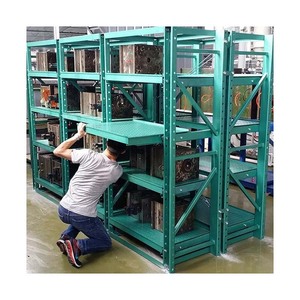
| Drawer-Type Mold Racks | High Concentration | Individual Drawer Access (100%) | Heavy Footprint Minimization | Overhead Bridge Crane / Monorail Hoist | High-torsion structural beam anti-tip lock |
| Heavy-Duty Carpet / Coil Racks | Medium-High | Direct Cradle Retrieval | Vertical Column Optimization | Forklift equipped with Boom/Mandrel | FEA localized point-load deflection analysis |
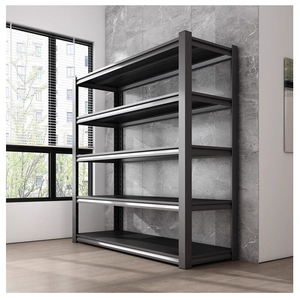
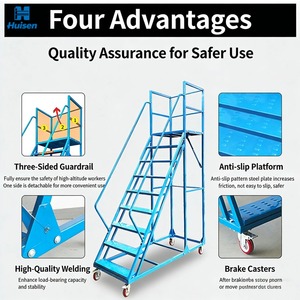
| Boltless Industrial Steel Shelves | Manual Pick Optimized | 100% Manual Hand-Loaded Access | Flexible Mezzanine / Multi-Tier | Manual Pick Carts, Rolling Safety Ladders | Uniformly Distributed Load (100–150kg/tier) |
Logistics operators and global supply chain directors face soaring commercial industrial real estate costs, tighter carbon footprint mandates, and accelerating warehouse automation. Sourcing modern warehouse racking requires strategic alignment with long-term technological convergence. The following fundamental industry procurement trends will dominate international warehouse storage supply chains over the coming decade:
Traditional manual forklift aisles are rapidly giving way to dense, floor-to-ceiling Automated Storage and Retrieval Systems (AS/RS) integrated with autonomous mobile robots (AMRs). Global procurement managers increasingly mandate tolerances measured in sub-millimeters rather than standard commercial margins. Uprights must withstand the relentless dynamic cycle fatigue imposed by 24/7 robotic shuttles operating at accelerations exceeding 2.5 m/s².
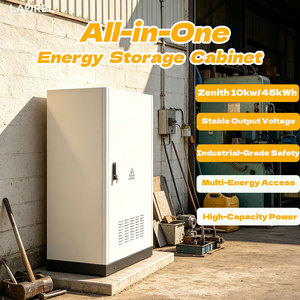
Warehouses are evolving into localized energy generation nodes. Procurement specifications now regularly combine mechanical storage racks with scalable LiFePO4 battery energy cabinets to buffer intermittent rooftop solar photovoltaic (PV) generation, power electric handling fleets, and maintain operational stability during grid outages without sacrificing warehouse square footage.
The era of static, unmonitored steel is passing. High-throughput distribution centers demand smart racks embedded with acoustic resonance and strain-gauge sensors that automatically identify micro-deflections caused by accidental forklift mast collisions. Predictive data triggers maintenance alerts via warehouse management systems (WMS) before catastrophic progressive collapse occurs.
With multinational ESG mandates tightening, global Tier-1 logistics providers specify cold-formed racking manufactured with low-embodied-carbon steel coils. Through micro-alloying with niobium and vanadium, higher tensile yield strengths (such as Q355B and specialized structural grades) allow for thinner gauge profiles without compromising allowable beam load or horizontal frame deflection ceilings.
Serving cross-border procurement teams across North America, Europe, the Middle East, Southeast Asia, and South America, we do not simply sell pallet racks; we engineer holistic material handling ecosystems. Here is how our comprehensive operational infrastructure safeguards your investment:
Every proposal begins with a complete digital twin of your warehouse floor. We account for slab floor bearing capacity, seismic acceleration coefficients (Ss, S1), building column obstructions, sprinkler drop heads, and specific forklift turning radii (AST) to generate fully optimized, hazard-free floor plans.
Exporting structural steel demands container space maximization. Our components are precision-nested into custom timber-cradled, steel-strapped bundles with corrosion-inhibiting VCI plastic wrap. We consistently achieve 95%+ 40ft High Cube container volumetric utilization, drastically lowering ocean freight overhead per pallet position.
Every export shipment is accompanied by complete mill test certificates (EN 10204 Type 3.1) proving chemical composition and yield stress properties. Finished uprights and beams undergo load testing verifying safety factors of 1.5 to 1.95 in accordance with European FEM 10.2.02 and American RMI MH16.1 specifications.
Direct technical answers addressing structural calculation, international logistics, installation timelines, and customized roll-forming specifications.
To produce an authoritative structural quotation, our engineering department requires:
Our structural design engineering team leverages ANSYS and STAAD.Pro finite element analysis (FEA) software configured to the rigorous demands of European standard FEM 10.2.02 (Steel Static Pallet Racking), American Rack Manufacturers Institute (RMI MH16.1), and Australian standard AS 4084-2023. We account for frame buckling, beam-end connector semi-rigidity (rotational spring constant test data), shear connector safety pin failure thresholds, and dynamic pattern loading. Factory production control adheres to ISO 9001 and CE certification criteria.
Yes. Beyond our standard 80mm, 90mm, 100mm, 120mm, and 140mm omega upright profiles, our in-house tool and die facility develops custom roll-forming tooling for OEM projects. We can fabricate matching tear-drop patterns for North American retrofits, hexagonal punching for European hooks, or custom high-capacity box-step beams for automated conveyor attachments. Surface finishes can be customized to any RAL color code or supplied in hot-dip galvanized steel (ISO 1461) for sub-zero cold storage and corrosive chemical environments.
Standard export production lead time ranges from 18 to 28 calendar days depending on tonnage (1 to 20 containers). Uprights are bundled flat with corrugated cardboard corner protectors and heavy industrial polyester strapping. Beams are palletized in interlocking bundles with steel separators to eliminate metal-on-metal transport abrasion. Every consignment includes color-coded assembly drawings, component bill of materials (BOM), and anchor torque specifications. We provide remote video installation guidance or dispatch certified project managers to oversee local mechanical installation teams globally.
Our flow-through pallet roller system utilizes engineered slope geometry (typically set between 3.5% and 4.0% gradient). To prevent heavy pallet acceleration down the lane, we integrate internal centrifugal speed controller rollers at regular intervals along each lane, ensuring pallet speed never exceeds 0.3 meters per second. At the picking face, heavy mechanical separators isolate the lead pallet from upstream line pressure, permitting safe, friction-free forklift extraction without load pinching or structural jamming.
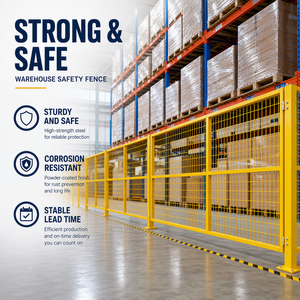
Over 80% of rack failures result from handling equipment collisions at aisle intersections. We engineer and supply structural steel wrap-around column protectors anchored directly into the concrete slab independently of the upright footplates. For row ends, we provide double-rail heavy tubular barriers with high-visibility safety yellow (RAL 1023) powder coating. For automated robotic workcells, our modular workshop safety mesh fences provide certified physical separation meeting OSHA and ISO 14120 safety guarding directives.
Connect directly with our senior intralogistics structural engineers. We provide comprehensive CAD warehouse floor plans, seismic structural calculations, and rapid competitive CIF/FOB export quotations tailored to your exact payload parameters.