Explore our heavy-duty cold-rolled steel storage systems engineered for maximum load capacity, strict safety compliance, and seamless logistics operation.
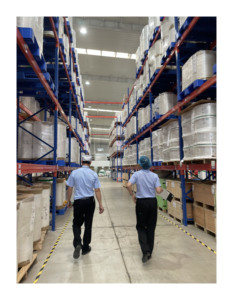
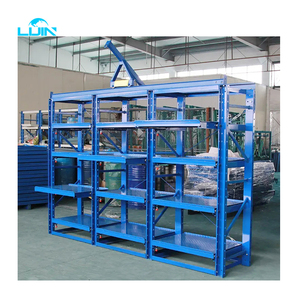
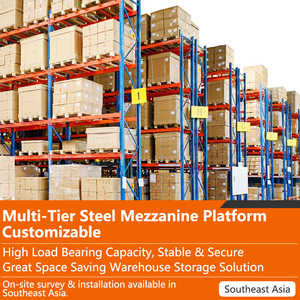
In modern industrial logistics, balancing operational velocity with spatial footprint efficiency presents a critical operational challenge. Double Deep Pallet Racking Systems represent a high-density evolution of standard selective pallet racking. By placing two rows of selective racking back-to-back, Double Deep systems eliminate 50% of the access aisles required in traditional single-deep configurations, effectively doubling storage capacity relative to aisle square footage.
Operating on a Last-In, First-Out (LIFO) inventory access principle, double deep systems require specialized material handling equipment—specifically specialized reach trucks equipped with telescopic pantograph attachments or deep-reach forks. The structural integrity of these racking systems depends upon high-tensile cold-rolled steel profiles, precise beam deflection limits (typically L/200 or L/300 according to European FEM 10.2.02 guidelines), and structural frame stiffness designed to resist dynamic forklift impacts and seismic acceleration forces.
As a leading global supplier and exporter, our double-deep system configurations utilize cold-rolled Q235B and Q355B structural grade steel profiles. The vertical frames consist of continuously cold-formed omega uprights featuring an 11-fold geometry to maximize cross-sectional moment of inertia while optimizing steel mass. Horizontal load beams are manufactured using heavy-duty twin-C box beam sections welded directly to heavy-gauge multi-hook end connectors, ensuring rigid frame connection and minimal frame sway.
A rigorous comparative analysis evaluating Double Deep Racking against competing industrial storage configurations.
| Racking Architecture | Floor Space Utilization (%) | SKU Accessibility | Aisle Width Required (mm) | Handling Equipment Type | Relative Capital Cost |
|---|---|---|---|---|---|
| Double Deep Racking | 60% - 65% | 50% Direct (LIFO per pair) | 3,000 - 3,400 | Pantograph Reach Truck | Medium (Optimal ROI) |
| Standard Selective Racks | 35% - 40% | 100% Direct (FIFO) | 3,500 - 3,800 | Standard Counterbalance / Reach | Low |
| Drive-In / Drive-Through Racks | 75% - 80% | Strict LIFO (Lane based) | 2,000 (Lane depth) | Standard Forklift | Medium-High |
| Very Narrow Aisle (VNA) Racks | 55% - 60% | 100% Direct (FIFO) | 1,600 - 1,900 | VNA Turret Truck / Articulated | High |
| Automated Push-Back Racks | 65% - 70% | LIFO (Cart-based) | 3,200 - 3,500 | Standard Forklift | High |
Selecting the optimal double-deep configuration requires precise evaluation of pallet dimensions, structural load limits, warehouse clear height, and forklift reach metrics.
Configured for high-bay logistics centers storing standardized EURO or GMA pallets weighing up to 1,500 kg per pallet position. Features reinforced frame bracing and bottom guide rails for high-reach stability.
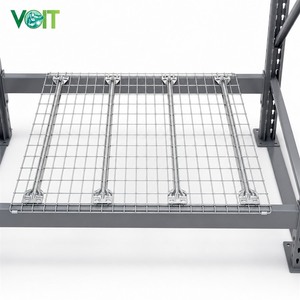
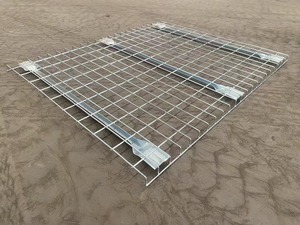
To enhance operational safety and fulfill local fire authority codes, pair double deep structures with heavy-duty wire mesh decks. Features formed U-channel support bars resting directly on step beams to prevent accidental pallet drop through deep storage slots.
Engineered for sub-zero food and pharmaceutical distribution facilities. Features hot-dip galvanized finishes (HDG according to ISO 1461) to withstand aggressive condensation cycles without coating degradation.
The global warehousing and material handling industry is undergoing a structural transition driven by rising commercial real estate land acquisition costs, strict ESG (Environmental, Social, and Governance) directives, and rapid automated robotics adoption. Procurement strategies for storage infrastructure are shifting from simple initial capital expenditure evaluation toward long-term total cost of ownership (TCO) and automation readiness.
Conventional double deep racking operated manually by reach truck drivers is evolving to integrate seamlessly with automated guided vehicles (AGVs) and vision-guided AMRs equipped with double-deep pantographs. Automated pallet positioning requires tighter tolerance manufacturing—reducing upright column bowing and beam deflection tolerances to within ±1.5 mm across 12-meter clear spans.
Global logistics suppliers are under strict corporate mandates to reduce Scope 3 embodied carbon footprint emissions. Leading double deep rack manufacturers are adopting ultra-high-strength steel (UHSS) grades (such as Q355B and specialized micro-alloyed steels) that allow thinner wall thicknesses while maintaining structural yield strengths above 355 MPa. Concurrently, zero-emission electrostatic powder coating and chromium-free passivation processes are becoming standardized procurement specifications.
Future high-bay double deep racking procurement contracts increasingly incorporate real-time IoT load-cell sensors and piezoelectric shock indicators embedded into lower-tier upright protectors. These sensors capture forklift impact energy data and beam over-deflection warnings, streaming alerts to warehouse management systems (WMS) to prevent catastrophic structural rack collapses.
Understanding the precision manufacturing standards required to produce safe, high-capacity, seismic-rated steel racking systems.
Manufacturing double-deep racking systems demands stringent dimensional control and state-of-the-art cold roll forming equipment. Unlike standard light-duty shelving, double deep racking beams and uprights absorb complex combined bending, torsional, and buckling moments.
Upright columns undergo continuous multi-pass CNC roll forming to shape heavy-gauge coil steel into complex 11-fold geometry, maximizing local and distortional buckling resistance.
Beam end-connectors are joined using robotic MIG welding stations to ensure complete root weld penetration. All cross-sections are pre-validated using Finite Element Analysis (FEA) under dynamic seismic loads.
Racking components undergo an 8-stage chemical wash, iron phosphate conversion, and deionized rinse prior to electrostatic epoxy-polyester powder baking (70-90 micron film thickness).
Operating from our modern production complex located in the Ajman Free Zone, United Arab Emirates, Signature Racking Systems F.Z.C brings over 20 years of continuous engineering expertise to the global material handling market. We function as a fully integrated, single-accountability partner—managing direct site surveys, CAD structural layout engineering, precision profile fabrication, rigorous factory quality testing, and international export packing.
Our in-house production facility houses high-speed continuous cold-roll forming lines, automatic CNC punch presses, high-precision hydraulic shears, and automated robotic welding cells. Owning every fabrication stage allows our engineering team to control dimensional tolerances tightly, deliver customized frame profiles for specialized reach trucks, and commit to strict export delivery schedules with absolute certainty.
Custom structural engineering drawings prepared to exact warehouse clear heights, column grids, and floor slab load-bearing capacities.
Components are bundled with heavy-duty steel strapping, edge protectors, and vapor-corrosion inhibitor (VCI) protective wrapping for safe ocean container freight.
All designs strictly comply with European FEM 10.2.02, Australian AS4084-2012, and American RMI safety guidelines for structural racking systems.
Detailed answers to structural, operational, and procurement queries raised by warehouse logistics managers and civil engineers.
Connect directly with our senior racking structural engineers for a free floor layout consultation, load capacity calculation, and detailed commercial project quotation.
Inquire Now