
Manufactured under strict ISO 9001 and CE execution classes. Browse our core warehouse storage systems, heavy-duty physical guard rails, and high-density material handling components.
Understanding how dynamic collision loads transfer through ductile steel profiles, elastomeric dissipation zones, and floor slab anchor arrays in modern automated intralogistics centers.
Industrial safety guard rails within European and global high-tier supply chain jurisdictions are governed by rigorous performance benchmarks. Under the Construction Products Regulation (CPR 305/2011) and the harmonized standard EN 1090-1 (Execution Class EXC2 and EXC3), structural barriers must maintain documented Factory Production Control (FPC). Furthermore, pedestrian and boundary segregation adheres to EN ISO 14122-3 and the internationally recognized impact protocol PAS 13:2017. These codes enforce clear criteria for dimensional tolerances, certified material yield limits, and impact deformation boundaries to guarantee that moving material handling equipment cannot breach protected zones.
The operational efficacy of a warehouse collision barrier is governed entirely by kinetic energy dissipation: Ek = ½mv2. When a 3,500 kg laden counterbalance forklift maneuvers at a standard cruising speed of 2.6 m/s (~9.4 km/h), the resulting gross impact energy equals approximately 11,830 Joules. A certified industrial guard rail system must not simply act as an unyielding wall; rigid, brittle barriers transfer immense shear forces directly into the floor anchors, inducing catastrophic concrete cone breakout. Advanced CE-certified barriers incorporate ductile steel profiles combined with energy-absorbing base mechanisms to elastically cushion the blow before undergoing controlled plastic deformation.
A safety rail is only as reliable as its substrate mechanical tie-down. Floor anchoring specifications demand precise engineering calculations regarding embedment depth, edge distance, and rebar clearance. Utilizing ETA-approved chemical capsule anchors or torque-controlled undercut steel expansion bolts ensures that dynamic shear and pullout forces are distributed uniformly across C20/25 to C30/37 concrete slabs. The barrier’s certified dynamic deflection zone must be accounted for during facility layout planning; if an end-of-aisle pallet rack sits merely 100mm behind a guard rail that possesses a certified 150mm deflection under maximum impact, the racking upright will absorb destructive collision shock.
| Barrier Classification | Primary Construction Material | Impact Rating (Joules) | Deflection Zone | Typical Strategic Application | Certification Baseline |
|---|---|---|---|---|---|
| Ultra Heavy-Duty Dual Rail | Q355B / S355JR Cold-Formed Steel | 18,000 – 25,000 J | Minimal (< 65 mm) | Main Forklift Thoroughfares, Loading Docks | EN 1090-1 EXC2, PAS 13 |
| Standard Single Rail Traffic | Q235B Tubular Structural Steel | 8,000 – 12,000 J | Moderate (< 120 mm) | Aisle Ends, Pallet Racking Frame Terminals | EN 15512, OSHA 1910.28 |
| High-Visibility Pedestrian Segregation | Modular Tubular Steel / Safety Yellow | 3,500 – 6,000 J | Low-Deflection Elastic | Walkways, Packing Stations, Canteen Access | EN ISO 14122-3, ISO 3864 |
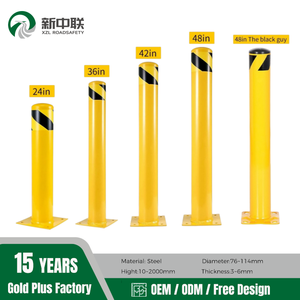
| Heavy Solid Cast Crash Bollards | Heavy Wall ASTM Steel Tube + Base Gussets | 14,000 – 22,000 J | Near Zero (< 35 mm) | Building Columns, Sprinkler Risers, Roll-Up Doors | PAS 13, ASTM F2656 Equivalent |
| Mezzanine Perimeter Edge Protection | Integrated Kick-Plate Steel Barrier | Static 1.0 kN/m Line Load | Rigid Structural Margin | Raised Mezzanine Floors, Pick Towers | EN ISO 14122-3, BS 6180 |
Operating from our modern facility in the Ajman Free Zone, UAE, with over two decades of engineering heritage, we deliver end-to-end manufacturing, custom roll-forming, and rapid global maritime logistics.
We eliminate trading intermediaries. Our factory features proprietary cold-roll forming lines, high-precision hydraulic CNC bending, automatic multi-station punching, and robotic CO2 gas-shielded structural welding that guarantee strict adherence to EN 1090-2 execution tolerances.
Every batch of guard rails, uprights, and baseplates is processed exclusively from mill-certified Q235B and Q355B coil stock. We issue full 3.1 Material Test Certificates (MTC) documenting tensile yield strengths, elongation capacity, and carbon equivalence metrics.
Components undergo an automated multi-stage pre-treatment wash, degreasing, and iron-phosphating cycle before receiving an electrostatic polyester architectural powder coating (70–90 μm thickness), providing salt-spray endurance exceeding 500 hours (ASTM B117).
Located in strategic proximity to major Middle Eastern commercial ports (including Jebel Ali, Dubai), we dispatch flat-packed, seaworthy containerized consignments worldwide, supported by complete bilingual layout schematics and rapid turnaround customs documentation.
How automation, AGVs/AMRs, sustainability mandates, and predictive sensor networks are revolutionizing warehouse physical containment systems worldwide.
The swift migration toward autonomous mobile robots (AMRs) and automated guided vehicles (AGVs) requires ground-level guard rail redesign. Modern facilities deploy dual-tier safety perimeters: an ultra-low floor-level kick plate (<100mm) that prevents AMR chassis low-center collisions, coupled with higher impact rails that guard against manned forklifts. Sensor-friendly non-reflective signal coatings and integrated LiDAR alignment bands prevent autonomous vehicles from experiencing laser blindness or mapping confusion along critical travel aisles.
Next-generation CE guard rails are increasingly integrated with embedded industrial IoT vibration, tilt, and micro-strain sensor nodes. Instead of relying on manual, periodic warehouse inspections under EN 15635, modern procurement officers are demanding smart bollards that transmit instantaneous collision alerts via LoRaWAN or Industrial Ethernet to the facility’s Warehouse Management System (WMS), pinpointing the precise location, timestamp, and G-force magnitude of impact events.
Global logistics operators such as DHL, Amazon, and Maersk now demand rigorous Environmental Product Declarations (EPD) for physical infrastructure. Procurement trends indicate a substantial preference for electric arc furnace (EAF) low-carbon steel, modular sacrificial components that allow localized rail replacement rather than full barrier scrapping, and solvent-free powder coatings, reducing embedded carbon by up to 42% over standard blast-furnace profiles.
Key architectural transformations shaping heavy-duty industrial guard rails over traditional rigid pipe fencing.
Traditional fully welded crash barriers require extensive cutting, on-site hot work permits, and structural recoating during repair. Current technical development focuses on modular slip-fit, pinned, or bolted upright-to-beam connectors. When an impact exceeds maximum elastic limits, only the damaged horizontal beam is unclipped and exchanged in minutes, reducing maintenance downtime by over 80% and preserving operational warehouse throughput.
The structural debate between pure steel and synthetic flexible polymer barriers has yielded innovative hybrid designs. Modern high-tier barriers utilize high-yield structural steel inner cores enveloped in UV-stabilized, self-colored polymer sleeves, backed by heavy-duty polyurethane elastomeric floor collars. This architecture pairs the absolute impenetrable stopping power of structural steel with the scratch-resistant, floor-friendly rebound dynamics of polymers.
Emergency preparedness guidelines (ISO 3864 and OSHA 1910.144) emphasize high physical barrier visibility during sudden blackout conditions. Incorporating co-extruded phosphorescent pigments into safety barrier top rails provides up to 90 minutes of glow-in-the-dark evacuation wayfinding guidance for personnel navigating dense pallet racking aisles, ensuring multi-hazard protection during fire or grid failures.
Direct technical answers addressing engineering certification, anchor loads, customs export compliance, and project planning.
Warehouse guard rails categorized as load-bearing structural safety components fall under the European Construction Products Regulation (CPR 305/2011) and must adhere to EN 1090-1 (Execution of steel structures and aluminum structures). To apply a valid CE mark, the manufacturing factory must maintain an audited Factory Production Control (FPC) system verified by a Notified Body, demonstrating compliance with Execution Class 2 (EXC2) or Class 3 (EXC3).
Furthermore, when barriers are designed for machinery access or personnel walkways, EN ISO 14122-3 standards apply, requiring specific railing heights (minimum 1100mm), intermediate knee rails, and continuous 100mm toe-boards (kick-plates) to prevent falling objects.
The Joule impact rating is calculated using the standard kinetic energy formula: E = ½ × m × (v × sin(θ))2, where:
• m = Total vehicle mass in kilograms (forklift unladen chassis weight + maximum rated pallet load).
• v = Operating speed in meters per second (1 km/h ≈ 0.278 m/s).
• θ = Impact angle relative to the barrier rail line (typically 90° for end-of-aisle bollards or 45°–60° for parallel traffic aisles).
For example, a typical 4,000 kg total gross weight forklift traveling at 10 km/h (2.78 m/s) striking an aisle barrier at an angle of 45° delivers approximately 7,720 Joules of dynamic energy. Our engineers recommend specifying guard rails with a minimum safety factor of 1.35x above your highest anticipated energy event.
Heavy-duty crash barriers demand a sound structural concrete substrate, typically a minimum compressive strength class of C20/25 to C30/37 (20 to 30 N/mm2 cylinder strength) and an uncracked floor depth of at least 150mm to 200mm. Standard anchor bolts are heavy-duty M12 to M16 mechanical wedge expansion anchors or M16 chemical capsule studs with an effective embedment depth (hef) of 85mm to 125mm.
Edge distances are critical: anchors installed closer than 150mm to an expansion joint or slab saw-cut risk concrete spalling and cone blowout under lateral collision impact. For slab thicknesses under 130mm, we specify oversized multi-point gusseted baseplates that disperse shear stresses across 4 to 6 anchor points.
PAS 13:2017 is the premier global code of practice for safety barrier impact testing. Unlike self-declared factory static push tests (which merely apply slow hydraulic pressure against a post), PAS 13 mandates rigorous dynamic impact physical crash tests using weighted vehicles or calibrated pendulum bobs striking the barrier at defined operational angles and velocities.
PAS 13 certifications provide certified measurement data on: (1) Maximum impact energy absorbed without catastrophic rupture, (2) Dynamic deflection during impact, and (3) Footplate and anchor shear integrity, ensuring that buyers acquire independently validated collision containment solutions.
Yes. While safety traffic yellow (RAL 1023 / RAL 1018) with contrasting black zebra warning chevrons is the standard industrial baseline under ISO 3864, we produce customized coatings across all European RAL colors. For sub-zero cold-chain facilities operating down to -30°C, we utilize Charpy V-notch impact-tested structural steel grades that resist cold embrittlement, paired with low-temperature curing polyester powders.
For outdoor loading docks, coastal environments, or external container yards, components undergo a dual-protective duplex cycle: Hot-Dip Galvanizing to EN ISO 1461 (minimum 55–85 μm zinc layer) followed by an architectural polyester powder coat for maximum UV and corrosion barrier protection.
Direct sourcing from Signature Racking Systems in the Ajman Free Zone, UAE, confers distinct financial and logistical advantages. First, operating in a free zone allows zero custom duty on prime raw material imports and direct factory export pricing without local value-added intermediary markups.
Second, our facility is situated adjacent to key maritime transshipment container ports (such as DP World's Jebel Ali Hub), ensuring low ocean freight rates, frequent vessel sailings, and rapid transit times to Europe, North America, the Middle East, and the Asia-Pacific region. All shipments include certified Chamber of Commerce Certificates of Origin, EUR.1 / GSP documentation where applicable, and detailed export packing manifests.
Warehouse steel safety guard rails, collision posts, and rack protectors are typically classified under HS Code 7308.90 ("Structures and parts of structures of iron or steel; plates, rods, angles, shapes, sections, tubes and the like, prepared for use in structures"). For specialized modular polymer barrier products, HS Code 3926.90 is utilized. Our experienced logistics desk ensures that export paperwork, commercial invoices, and packing lists are strictly aligned with destination customs classification codes to avoid clearance delays.
Because all cold-roll forming, cutting, punching, welding, and powder coating lines are vertically integrated inside our Ajman factory, standard production lead time for standard FCL (20ft or 40ft High Cube) orders is typically 14 to 21 working days following CAD drawing sign-off. Highly customized architectural fabrications, non-standard bespoke heights, or duplex hot-dip galvanized specifications require approximately 25 to 30 working days.
Consult directly with our structural engineering and export advisory team. Receive optimized CAD layout drawings, finite element impact calculations, and transparent factory-direct pricing for your logistics facility.
Get a Quote