Precision-engineered storage systems designed to maximize vertical cubic volume, withstand demanding mechanical loads, and streamline long-goods distribution across South America.
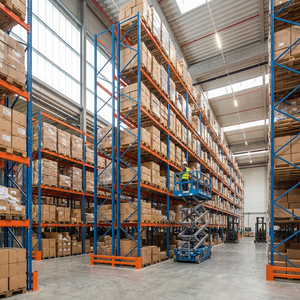
Managing cylindrical profiles, rigid steel tubing, PVC conduits, and structural lumber requires eliminating point-load failures, preventing profile rolling, and ensuring unyielding lateral stability under seismic and static stresses.
Unlike pallet racking bounded by horizontal beams, cantilever arms act as pure flexural members subjected to asymmetric bending moments. Our systems utilize variable section tapered arms engineered with an inherent 2° to 4° upward pitch. This counteracts mechanical deflection under full rated capacities (up to 5,000 kg per arm), neutralizing the hazard of rolling tubular goods migrating toward aisle perimeters.
For extreme pipe warehousing, we manufacture upright columns from hot-rolled wide flange IPE and HEA profiles conforming to ASTM A36 and S355JR standards. By comparison, light-to-medium pipe applications utilize continuous cold-roll-formed profiles with reinforced double-lipped upright designs. This provides exceptional torsion resistance during overhead crane and sideloading handling cycles.
Pipe stability demands purpose-built physical interfaces. Every cantilever system exported to Uruguay can be configured with removable or fixed front vertical pipe stops (100mm to 300mm height), concave cradle saddles, or non-marking polyurethane contact strips that prevent contact fretting, ovalization, and protective coating degradation on stainless steel or smooth polymer conduits.
Every pipe rack structure destined for South American deployment undergoes Finite Element Analysis (FEA) verifying axial, shear, and buckling limits under both uniform distributed loads (UDL) and severe localized impact forces. Our manufacturing tolerances align rigorously with European FEM 10.2.02 and EN 15512 codes, while anchoring layouts are adapted to the concrete slab specifications common across Uruguayan industrial estates (minimum H-25 to H-30 reinforced industrial flooring with M12/M16 chemical expansion bolts).
| System Architecture | Primary Material Grade | Arm Capacity Range | Ideal Length Profiles | Typical Uruguay Application |
|---|---|---|---|---|
| Structural I-Beam Cantilever | Q355B / S355JR (Hot-Rolled) | 1,200 kg – 5,000 kg / Arm | 6.0m – 12.0m Bundles | Heavy steel tubes, casing pipes, forestry boom sections |
| Roll-Formed Heavy Cantilever | Q235B / S235JR (High-Yield Cold Form) | 400 kg – 1,200 kg / Arm | 3.0m – 6.0m Tubing | PVC / HDPE irrigation pipes, electrical conduit bundles |
| Vertical A-Frame Pipe Rack | Heavy Gauge Structural Tubing | 250 kg – 600 kg / Compartment | 2.0m – 4.5m Vertical Storage | Retail plumbing yards, maintenance workshops, retail outlets |
| Specialty Pigeon-Hole Racks | Cold-Rolled Sheet + Structural Angle | 1,000 kg – 2,500 kg / Level | Up to 6.0m Internal Depth | Precision copper pipes, aluminum extrusion profiles, molding |
Uruguay’s geographic positioning as Mercosur’s transshipment gateway demands versatile, high-density storage configurations suited to maritime trade, agro-industry, forestry pulp logistics, and civil water networks.
Operating under Uruguay’s Free Port Law (Ley de Puerto Libre Nº 16.246), logistics warehouses in Puerto de Montevideo and the adjacent Ruta 101 corridor function as multi-modal consolidation nodes. Our heavy-duty cantilever systems enable zero-tariff re-export operators to stage massive steel drill pipes, casing tubes, and structural steel beams transitioning from deep-sea container vessels to river barges heading up the Hidrovía Paraná-Paraguay.
Industrial installations supporting the UPM (Fray Bentos & Paso de los Toros) and Montes del Plata operations require uninterrupted spare-parts availability. Heavy-duty pipe racks engineered with corrosive-resistant finishes house stainless steel hydraulic tubing, steam delivery pipes, industrial heat exchanger bundles, and long chemical conduits, ensuring fast picking during high-tempo maintenance turnarounds.
Uruguay’s intensive agriculture across Soriano, Colonia, and Rio Negro relies heavily on mechanized pivot irrigation and deep water conveyance. Cantilever pipe storage yards store large bundles of HDPE, PVC, and galvanized steel piping. Featuring custom tiered arm configurations, these systems prevent polymer pipe ovalization caused by prolonged ground-level stack pressures during humid summer periods.
With Uruguay generating over 95% of its electricity from renewable sources, massive utility-scale photovoltaic farms and wind repowering projects in Salto, Artigas, and Tacuarembó demand organized on-site laydown areas. Our outdoor-rated galvanized pipe racking houses structural torque tubes, pile-driven mounting poles, electrical conduit bundles, and mast assemblies prior to field installation.
Municipal infrastructure overseen by OSE (Obras Sanitarias del Estado) utilizes our medium-to-heavy pipe racking within central maintenance warehouses in Canelones and San José. Segregated multi-level arm layouts allow maintenance teams to cleanly index ductile iron pressure pipes, repair sleeves, and valves by pressure rating and diameter, reducing municipal repair deployment times.
Metropolitan Montevideo construction suppliers utilize high-bay cantilever towers connected to 4-way reach trucks or side-loaders. By transitioning from floor stacking to vertical cantilever pipe racks, stockists increase floor storage density by over 320% while eliminating worker injury risks associated with manually prizing rolled tubes from grounded honeycombs.
Strategic investments in multi-modal infrastructure, free trade parks, and sustainable industrial warehousing are transforming long-goods inventory management across Uruguay.
Uruguay's Free Zone Law (Ley Nº 15.921) has catalyzed massive capital commitments in logistics parks surrounding Montevideo and Canelones. Warehousing facilities within Zonamerica, Parque de las Ciencias, and Plataforma Logística Ruta 101 are facing rising industrial square-meter lease rates. In response, operators are moving away from traditional horizontal floor staging toward 8-to-11-meter vertical cantilever racking systems. These high-density configurations unlock vertical cubic volume and provide immediate stock picking accessibility essential for regional Mercosur distribution contracts.
Operating within immediate proximity to the Río de la Plata estuary and the South Atlantic Ocean exposes racking steelwork to continuous marine salinity and humidity levels averaging 75–85%. Uruguayan industrial specifications now heavily reject single-coat standard alkyd paints. The prevailing market trend specifies a minimum 80–120 micron thermosetting epoxy-polyester powder coating for indoor facilities, and full ISO 1461 hot-dip galvanization for coastal staging depots and unconditioned open-sided agricultural pipe sheds.
To recover valuable warehouse floor area, leading Uruguayan distribution centers are upgrading their material handling fleets from standard counterbalance forklifts (which require wide 5.5m+ aisles for long pipes) to multi-directional reach trucks, electric sideloaders, and articulated forklifts. As a result, modern pipe racking installations must incorporate mechanical floor-mounted guide rails, entrance chamfers, and ultra-flat floor anchoring designs that narrow aisle clearance down to 2.2–2.8 meters.
With the rapid adoption of enterprise ERP/WMS platforms by Uruguayan industrial conglomerates, pipe racks are no longer treated as passive steel skeletons. Facilities require integrated bar-code labeling channels, load cell retrofitting options, and subdivided partition pins. This configuration allows bar stock, conduit types, and wall-thickness variations to be tracked with individual serial numbers, accelerating order fulfillment for engineering and construction clients.
With over two decades of heavy industrial fabrication pedigree, we combine state-of-the-art roll-forming lines, certified robotic welding, and rigorous load testing to supply mission-critical storage assets worldwide.
Our dedicated production plant integrates high-tonnage multi-station roll-forming lines, automated CNC punching, and hydraulic pressing units. This gives us total control over dimensional tolerances and structural repeatability.
All critical cantilever arm connectors, column baseplates, and bracket assemblies are fabricated using certified multi-axis robotic welding cells, verified by ultrasonic non-destructive testing (NDT) to prevent structural weld failure under cyclical loads.
Shipments destined for Puerto de Montevideo are packed with heavy-duty structural steel banding, protective edge guards, moisture-barrier wrapping, and custom dunned cradles designed for seamless container destuffing via overhead cranes or standard forklifts.
Every order is accompanied by comprehensive engineering calculations, 3D structural CAD layouts, and clear anchor installation blueprints. We work directly with Uruguayan civil engineers to verify concrete load bearing before fabrication begins.
Direct answers to procurement, customs classification, maritime transit, and structural engineering questions raised by warehouse operators in Uruguay.
Industrial steel racking systems imported into Uruguay typically clear customs under Mercosur Harmonized System Code (NCM) 7308.90 (Structures and parts of structures of iron or steel). For projects located in bonded zones such as Zonamerica, Parque de las Ciencias, or under the Free Port Regime at Puerto de Montevideo (Ley 16.246), items enter with direct exemption from import tariffs (Arancel Externo Común) and VAT (IVA) while staged for re-export or local processing. We supply complete commercial documentation including mill test certificates (EN 10204 Type 3.1), stamped packing lists, bills of lading (BL), and certified structural layout drawings to ensure zero friction with Dirección Nacional de Aduanas (DNA).
Given Uruguay’s humid subtropical climate and constant maritime salt spray along the Río de la Plata and Atlantic coastline, corrosion protection is paramount. For indoor temperature-controlled warehouses, we employ a multi-stage chemical wash and iron phosphate pre-treatment followed by an electrostatic thermosetting polyester powder coat cured at 200°C (yielding 80–120 microns DFT, ISO 12944 C2/C3 durability). For outdoor pipe yards, agricultural supply centers, or open dock sheds, we provide components hot-dip galvanized in accordance with ISO 1461 / ASTM A123, delivering a metallurgical zinc alloy layer exceeding 85 microns that offers maintenance-free rust resistance in C4 and C5 marine environments for over 25 years.
Yes. Pipe materials exhibit vastly different mechanical flexural characteristics. Heavy steel drill casing pipes require high-point-load arm capacities with front mechanical safety retaining pins. Conversely, flexible polyethylene (HDPE) and PVC pipes tend to sag or deform when supported by widely spaced cantilever arms. For polymer pipe storage in Uruguay, we design systems with reduced column center spacing (1,000mm to 1,200mm) combined with continuous wire mesh decking, solid galvanized steel shelf panels, or saddle cradles lined with non-abrasive elastomeric strips to guarantee zero ovalization or surface indentations.
Our engineering team calculates member stresses, overturning stability, and connection ductility in accordance with European standard FEM 10.2.02 (The Design of Cantilever Racking) and EN 15512:2020, supplemented by American RMI (Rack Manufacturers Institute) MH16.1 specifications. While Uruguay is classified as a low-to-moderate seismic zone according to regional geodynamic surveys, our structural baseplates are calculated with generous safety margins (minimum 1.5 to 2.0 safety factor against combined dead and dynamic live loads) and anchored using high-tensile mechanical expansion anchors or Hilti chemical anchoring capsules into certified reinforced concrete slabs.
Standard manufacturing lead times for customized cantilever and pipe racking orders typically range from 15 to 25 working days, depending on total tonnage, column height, and whether powder-coated or hot-dip galvanized finishing is selected. Ocean freight from major shipping terminals to Puerto de Montevideo (TCP - Terminal Cuenca del Plata) requires approximately 32 to 42 days transit time via direct container vessel services (Hamburg Süd, Maersk, MSC, or Cosco). We coordinate directly with your appointed Uruguayan despachante de aduana (customs broker) or provide CIF/CFR quotes directly to Montevideo.
All pipe racking systems are manufactured on a knock-down, bolt-together modular framework. We eliminate complex on-site welding entirely. Shipments include detailed 3D step-by-step assembly schematics, numbered component tagging, bolt-torque specifications, and heavy-duty steel shims (1mm to 5mm) to correct uneven warehouse floor elevations. Uruguayan contractors or internal maintenance teams can erect systems rapidly using standard boom lifts and torque wrenches. Alternatively, we can provide direct technical supervision or recommend accredited regional installation crews familiar with local safety regulations (BPS and Ministerio de Trabajo y Seguridad Social guidelines).
Connect directly with our structural engineering team. Submit your warehouse floor plan, maximum pipe bundle weights, and target clear heights to receive a detailed CAD layout, load capacity analysis, and landed quotation within 48 hours.
Get Catalog