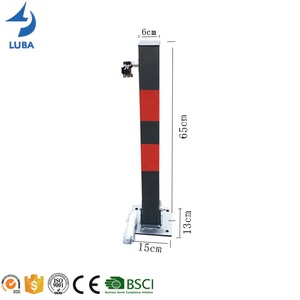

Precision-fabricated using robotic circumferential welding, high-tonnage stamping, and thermoset electrostatic powder coat finishes. Explore our factory-direct wholesale catalogue configured for logistics terminals, loading docks, and automated fulfillment centers.
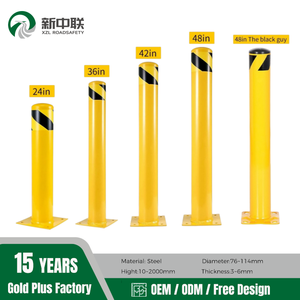
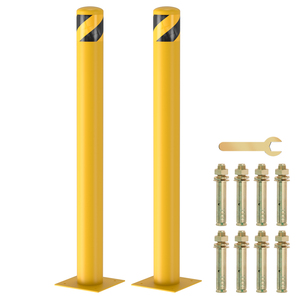
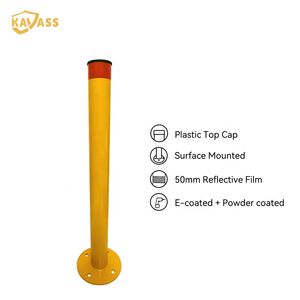
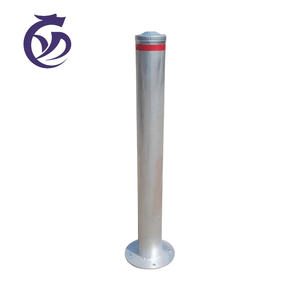
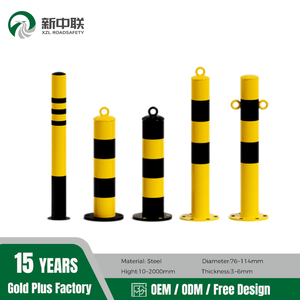
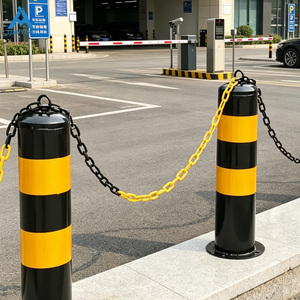
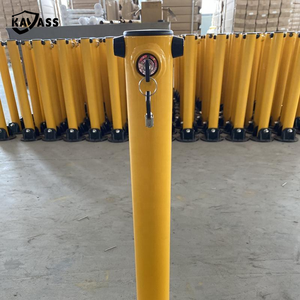
In modern high-throughput logistics hubs, material handling equipment (MHE) operates at higher speeds and narrower aisle tolerances than ever before. When specifying warehouse safety bollards, engineering teams must look beyond superficial aesthetics and evaluate kinetic energy impact ratings expressed in Joules ($J$). The kinetic energy ($E_k$) transferred during a vehicle collision is determined by the equation:
Kinetic Energy Formula: E_k = 0.5 × m × v²
Where m represents gross operational mass (vehicle + full pallet tare load in kg) and v represents transit velocity in meters per second (m/s). For instance, a typical 3.5-ton counterbalanced forklift traveling at an operational speed of 12 km/h (3.33 m/s) delivers an unmitigated kinetic shock wave of approximately 19,400 Joules upon impact.
Without engineered safety stanchions anchored directly into reinforced concrete floor slabs, this uncontrolled shock wave transmits directly into vertical structural elements: building support columns, pallet racking uprights, electrical distribution busways, or pedestrian walk corridors. As a premier Chinese manufacturing partner, our engineering team executes Finite Element Analysis (FEA) on cold-formed hollow structural sections (HSS) to verify yield strength, section modulus, and anchoring bolt shear limits under peak loads.
| Bollard Model Class | Material Specification | Wall Thickness (δ) | Impact Threshold (Joules) | Recommended Industrial Placement |
|---|---|---|---|---|
| Light-Duty Separation | Q235 Carbon Steel Tubing | 3.0 mm - 4.5 mm | Up to 3,500 J | Pedestrian Walkways, Office Partitions, Low-Speed AGV Corridors |
| Medium-Duty Flange Mount | Q235B Cold Drawn Pipe | 4.5 mm - 6.0 mm | Up to 12,000 J | Aisle-End Rack Protectors, Battery Charging Bays, Conveyor Lines |
| Heavy-Duty Concrete Core | Q355B Seamless Steel Pipe | 6.0 mm - 12.0 mm | Up to 28,000 J | Overhead Door Portals, Loading Dock Levelers, Column Protection |
| Extreme Crash Stanchion | ASTM A500 Grade B / C Structural | 12.0 mm - 16.0 mm | Up to 55,000+ J | External Tank Farms, High-Bay Racking Terminals, Hazardous Chemical Storage |
Our manufacturing protocols leverage Q235 and Q355B low-alloy structural steel, providing optimum balance between ultimate tensile strength (σb: 470–630 MPa) and elongation capacity (≥ 21%). This specific mechanical profile prevents catastrophic brittle fractures upon high-speed impact, allowing the steel cylinder to yield plastically while safely dissipating collision energy away from structural building columns.
How global supply chain leaders, warehouse project managers, and automated terminal developers are restructuring their factory perimeter and internal safety asset sourcing strategies.
Global procurement teams are systematically phasing out regional trading middlemen in favor of direct engagement with tier-one Chinese fabrication plants. Direct procurement delivers 25% to 40% capital expenditure savings, guarantees mill test certificates (MTC EN 10204 3.1), and shortens custom CAD-to-container lead times down to under 20 business days.
The explosive rollout of autonomous mobile robots (AMRs) requires physical barriers that interact cleanly with LiDAR and optical safety systems. Modern procurement focuses on high-contrast matte finishes, anti-glare micro-prismatic sheeting (ASTM D4956 Type IV), and standardized radar-reflective profiles that safeguard delicate automated picking grids from human forklift incursions.
Purchasing agents are transitioning from lowest-initial-cost disposable bollards to modular surface-mount systems with sacrificial anchor sleeves. Replaceable post assemblies eliminate concrete slab demolition costs when a terminal impact occurs, reducing post-collision facility downtime by over 80% while retaining structural substrate integrity.
Delivering high-reliability warehouse safety infrastructure at scale requires substantial capital investment in automated steel processing equipment. Unlike low-tier assembly workshops, integrated Chinese safety barrier manufacturers maintain full in-house control over the entire production cycle:
1. Multi-Axis Fiber Laser Cutting & Coping: Raw steel hollow sections are cut to exact design elevations with micro-metric dimensional tolerance (±0.3mm). Automated rotary chucks execute clean coping and pre-form anchor bolt relief holes directly into baseplates without structural heat warping.
2. Continuous Robotic Seam Welding: Base flanges are welded using Panasonic multi-axis robotic MAG welding stations using high-purity argon-CO2 shielding gas mixtures. This process eliminates human weld undercut, porosity, and cold-lap defects, producing full-penetration fillet welds certified to AWS D1.1 and EN ISO 15614 structural codes.
3. Multi-Stage Chemical Pre-Treatment: Before powder application, each bollard cylinder undergoes hot alkaline degreasing, iron phosphate conversion coating, and high-pressure deionized water rinses. This ensures complete removal of mill scale, industrial oils, and oxidation, creating an optimal microscopic surface tooth for protective coatings.
4. Electrostatic Thermoset Polyester Powder Coating: Utilizing automated Nordson powder delivery guns, a uniform 80–120 μm layer of exterior-grade TGIC polyester resin is applied and cured in a 200°C convection oven. The cured finish delivers superior impact flex without micro-cracking, rated for 1,000+ hours of continuous salt spray testing under ASTM B117 standards.
Continuous profile roll forming ensures uniform wall thickness and concentricity across all structural steel calibers.
High-tonnage hydraulic presses stamp baseplates up to 25mm thickness with counter-sunk anchor relief slots.
Our engineering office produces DWG/Revit layout models tailored directly to your floor clearances and column spans.
Knock-down seaworthy steel-crated packing with rust-preventive VCI wraps designed for zero ocean-transit damage.
Unlike specialized hardware-only vendors, our manufacturing roots are deeply tied to total industrial warehouse engineering. With over 20 years of hands-on heavy-duty structural steel fabrication experience, our operations encompass high-bay selective pallet racking, drive-in systems, structural mezzanine floors, and heavy-duty impact barrier networks. This holistic perspective provides distinct technical advantages to international enterprise buyers:
Integrated Load-Path Cohesion: Warehouse safety bollards cannot be designed in isolation. They serve as the first line of defense for upright pallet frames, rack load supports, and structural building stanchions. Because we design and fabricate both the storage racking systems and the exterior safety bollards, we calculate load-path mechanics and deflections holistically, ensuring that an impact against an aisle bollard never transfers secondary rotational bending moments into the pallet racking uprights.
Single-Source Factory Accountability: Managing separate suppliers for pallet racking, wire decking, machine safety cages, and perimeter steel bollards increases shipping friction, procurement overhead, and dimensional coordination errors. We supply entire logistics facilities directly: containerized, color-coded, bundled with all Grade 8.8 wedge anchor hardware, assembly manuals, and comprehensive CAD site maps.
Custom OEM/ODM Engineering: Looking for proprietary baseplate configurations, specific heights (800mm, 900mm, 1000mm, 1200mm, or 42"), custom RAL powder coat matching, or integrated top chain eyes? Our engineering team delivers 3D prototype files within 24 hours of receiving site specifications.
Direct, technical answers addressing the critical mechanical, logistical, and compliance questions asked by procurement directors, civil contractors, and facility engineers.
The choice depends on floor structural integrity and anticipated impact energy. Surface-mounted bollards use heavy baseplates (10mm to 20mm thickness) secured with 4 to 8 concrete wedge or chemical anchors. They install rapidly without core drilling, making them ideal for existing slabs and rack-end aisle protection. Core-drilled embedded bollards are set 200mm to 500mm into the concrete slab and filled with concrete; they deliver maximum crash resistance for loading docks, building corner columns, and heavy forklift avenues.
We fabricate our bollards primarily from certified Q235B and Q355B structural carbon steel, conforming to ASTM A500 Grade B/C equivalents. Standard pipe outside diameters range from 3.5 inches (89mm), 4.5 inches (114mm), 5.5 inches (140mm), up to 8.6 inches (219mm). Wall thicknesses range from economical 3.0mm profiles up to 16.0mm heavy-duty anti-ram schedule 80 steel cylinders, fully customizable per project FEA requirements.
For outdoor loading yards, cold storage docks, or marine-adjacent distribution centers, we implement a dual-layer duplex coating: hot-dip galvanization conforming to ISO 1461 / ASTM A123 (minimum 85 μm zinc layer), followed by surface sweep blasting and electrostatic architectural-grade polyester powder coating (80–100 μm). This dual barrier withstands over 1,500 hours of continuous ASTM B117 salt spray exposure without blistering or under-film corrosion creep.
Because we operate continuous high-capacity roll forming and robotic welding lines, our standard commercial MOQ for customized warehouse safety bollards is 50 units, or combined full-container loads (20GP / 40HQ) with mixed warehouse safety products. Functional pre-production physical prototypes are produced and dispatched via air courier within 5 to 7 working days against client CAD drawings.
Yes. Our designs adhere to OSHA 1910.28 / 1910.144 regulations for safety color coding (high-visibility safety yellow RAL 1023 or RAL 1021) and geometric clearances. For European and British Commonwealth applications, our engineering matches EN 15512 warehouse tolerances and BS 6180 barrier deflection standards, incorporating Class 1 / Class 2 diamond-grade retroreflective bands for low-visibility operations.
We supply complete turn-key installation kits. Depending on your concrete compressive strength (psi / MPa), we package Grade 8.8 zinc-plated or 304/316 stainless steel heavy-duty wedge expansion bolts, drop-in anchors, or high-shear threaded studs suitable for epoxy chemical capsule grouting. Anchor counts, hole pitch diameters, and torque specifications are detailed on each installation drawing.
Each individual bollard post is sleeved in a non-abrasive expanded polyethylene (EPE) foam jacket, wrapped with sealed moisture-barrier stretch film, and placed into heavy timber or steel-frame stackable export pallets. Corners and reflective bands are reinforced with heavy-duty cardboard edge guards, ensuring complete finish protection during multiple container handling steps and intermodal ocean transit.
To receive an itemized quotation within 24 hours, provide: (1) Desired bollard height and tube diameter, (2) Mounting style (baseplate flange surface-mount or in-ground embedded core), (3) Anticipated forklift traffic weight and operational speed, (4) Surface finish requirements (indoor powder coat vs. outdoor hot-dip galvanized), and (5) Project volume and destination seaport for CIF/FOB calculations.
Consult with our structural engineering team today to review your warehouse CAD layout, calculate kinetic impact ratings, and receive an itemized factory-direct wholesale quotation.
Get a Quote