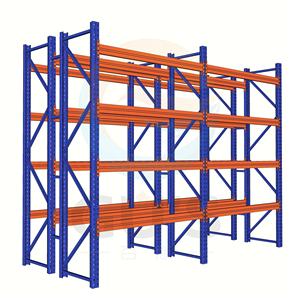
Explore heavy-duty modular stacking racks, warehouse automation hardware, and intralogistics systems manufactured for rigorous export specifications.
Analyzing structural dynamics, steel metallurgies, cup-and-cone alignment physics, and export quality verification.
In modern international warehousing, distribution centers, and flexible manufacturing hubs, static storage fixtures are increasingly superseded by high-density, portable structural storage solutions. Metal stacking racks—variously classified across industrial supply chains as Manuracks, demountable post pallets, nestable tire stillages, or modular box pallets—represent the intersection of heavy load capacity and dynamic floor utilization. Unlike conventional bolted or roll-formed selective pallet racks anchored permanently into concrete slabs, metal stacking racks convert open floor space into high-density multi-tiered vertical storage without permanent civil engineering modifications.
As an established industrial manufacturing exporter, structural safety begins at the steel slitting and coil unwinding phase. Stacking racks depend on axial compressive column strength transferred through vertical corner posts to the heavy base framework. Under continuous cyclic static loads exceeding 1,500 kg per level, coupled with dynamic forklift shock vibrations, material yield thresholds are paramount.
Standard commercial racks typically employ carbon steel Q235B (yield strength $f_y \ge 235 \text{ MPa}$, ultimate tensile strength $370\text{--}500 \text{ MPa}$), which offers balanced ductility, cost-effectiveness, and weldability. However, for cold-storage applications operating at temperatures down to $-30^\circ\text{C}$, or high-bay facilities stacking 4 to 6 units high, certified Chinese manufacturing exporters engineer racks utilizing low-alloy high-strength structural steel Q355B (yield strength $f_y \ge 355 \text{ MPa}$, tensile strength $470\text{--}630 \text{ MPa}$). The heightened tensile capacity mitigates brittle failure risks under cold operating conditions and allows for optimized wall thickness (typically 2.5 mm to 3.5 mm cold-formed rectangular hollow sections) without adding excess tare deadweight that penalizes ocean freight payload limits.
To quantify capital expenditure (CAPEX) versus operational expenditure (OPEX) efficiencies, the engineering matrix below contrasts China-manufactured heavy metal stacking racks with conventional warehouse racking topologies.
| Technical Parameter | China Metal Stacking Racks | Standard Selective Pallet Racks | Drive-In / Drive-Through Systems | Automated Crane ASRS |
|---|---|---|---|---|
| Floor Anchoring / Civil Work | Zero (Self-supporting structural base) | Mandatory (Chemical or expansion anchors) | Mandatory (Heavy base anchoring) | Extreme (High-flatness slab class 1) |
| Dynamic Stacking Height | Up to 4–6 tiers high (1+3 to 1+5) | Limited only by building height | Typically 3 to 5 pallets deep/high | Exceeds 25 to 40 meters |
| Unit Load Capacity (Dynamic/Static) | 1,000 kg – 2,500 kg / Tier | 800 kg – 2,000 kg / Beam Level | 1,000 kg – 1,500 kg / Lane Rail | 1,000 kg – 1,800 kg / Cradle |
| Reverse Logistics & Storage Efficiency | High (Posts demounted or bases nested) | Nil (Permanent infrastructure) | Nil (Fixed structural uprights) | Nil (Stationary automated machinery) |
| Forklift Mast Damage Vulnerability | Minimal (Entire unit shifts on contact) | Severe (Risk of progressive upright collapse) | High (Vulnerable entry upright posts) | N/A (Enclosed robotic aisle) |
| Freight Shipping Density (40ft HQ) | High: 180–300 knock-down units | Moderate: Beams & disassembled frames | Low-Medium: Long rail structures | Specialized crating & machinery |
The core mechanical interface governing operator safety in high-stack environments is the interlocking post connection. High-tier stacking racks incorporate either flared cup-and-cone sockets, inverted pyramid target shoes, or high-precision nesting alignment caps. During crane or forklift elevation, visual alignment parallax makes pinpoint millimeter positioning impossible for reach truck drivers.
Our precision-tooled stacking cups deliver an engineered mechanical lead-in tolerance of approximately $35\text{ mm}$ radial play, self-centering the descending vertical upright into its lower cradle pin via gravity-assisted bevels. Once seated, the mechanical interface provides positive, moment-resisting shear restraint designed to meet RMI (Rack Manufacturers Institute) MH16.1 and FEM 10.2.02 structural deformation thresholds under horizontal deflection scenarios.
China export factories produce engineered structural stacking systems categorized by modular physical profile and cargo interface.
Engineered with heavy tubular base profiles and 4 removable upright poles. Accommodates standard European (1200x800mm) or American (48x40in) wooden pallets. Delivers full perimeter access for forklifts and pallet trucks while preventing product compression damage on lower tiers.
Constructed with cold-drawn high-tensile wire mesh welded to an structural angle base. Designed with drop-gates for ergonomic inventory retrieval when stacked. Essential for automotive stamped components, castings, irregular plastic sub-assemblies, and heavy scrap handling.
Custom-engineered saddles and bottom cross-braces specifically designed to cradle passenger (PCR), commercial (TBR), and agricultural tires in tread-down or barrel-stacked arrays. V-shaped base designs interlock when empty, allowing up to 70% floor space reclamation.
Designed for profiles exceeding 6 meters in length, including steel structural conduits, copper tubes, and aluminum extrusions. Equipped with heavy-gauge side arms and certified lifting eye lugs for dual overhead overhead crane and forklift transfer.
How automation compatibility, sustainability compliance, and total cost of ownership (TCO) are transforming B2B purchasing decisions.
Procurement teams are prioritizing base clearances engineered specifically for autonomous mobile robots. This requires high-precision robotic welding to achieve base dimensional tolerances within ±1.5mm, paired with optical reflector brackets and QR-code positioning pads on rack bases.
Global multi-national buyers now require environmental product declarations (EPD) and mill test certificates indicating EAF (Electric Arc Furnace) scrap recycled steel content. Chinese exporters are aligning supply chains to minimize embedded manufacturing carbon emissions per metric ton produced.
Industrial stacking racks operating across closed-loop 3PL networks are increasingly procured with factory-recessed active or passive RFID / BLE tag enclosures. This preserves track-and-trace integrity through hostile shipping environments, reducing container loss rates in cross-border circuits.
Transitioning from labor-intensive welding workshops to smart robotic automated production lines.
The production of industrial steel stacking racks has undergone a technological shift across leading Chinese manufacturing hubs. The historical reliance on manual gas-metal arc welding (GMAW) and sheared tube profiles has been replaced by integrated fiber laser tube cutters, multi-axis automated welding cells, and automated multi-stage continuous pretreatment conveyor powder coating systems.
Fiber laser tube-cutting centers with automatic bundle loading notch, cope, and slot hollow structural sections with ±0.2mm precision, eliminating burrs and ensuring precise interlocking joints.
High-speed 6-axis welding robots synchronized with dual-station tilt-turn positioners ensure full weld penetration on critical cup-to-post and corner collar joints under inert gas shielding.
Components pass through automated alkaline degreasing, zinc-phosphate conversion coating, and DI-water cascades to create optimal surface anchor profiles for superior coating adhesion.
Dual-reciprocator powder booths apply 70–100μm thick thermosetting polyester resins, cured in convection ovens at 200°C for high resistance against forklift impact and chemical abrasion.
For extreme environments such as cold-storage warehouses, marine ports, or chemical fertilizer plants, Chinese exporters provide Hot-Dip Galvanizing (HDG) per ISO 1461 / ASTM A123 standards. Fabricated components are fully submerged in molten zinc at 450°C, forming metallurgically bonded iron-zinc alloy layers providing cathodic self-healing corrosion protection exceeding 25 years.
Comprehensive manufacturing, CAD structural layout simulation, and reliable container packaging protocols.
Every custom stacking rack quotation is accompanied by dynamic load simulation reports and CAD layout designs. We calculate horizontal drift ratios and frame buckling stability factors, ensuring complete structural integrity before steel cutting begins.
From chemical optical emission spectroscopy verifying steel melt composition to hydraulic press proof-load testing at 150% nominal design rating, every production run is certified with complete traceability documents and weld inspection records.
We eliminate "paying to ship air" by engineering modular, knocked-down or nested stacking bases secured with high-tensile steel strapping, heavy timber dunnage, and VCI vapor corrosion inhibitor packaging to endure long marine transit intact.
In-depth engineering answers to common procurement questions from warehouse operators and global supply chain directors.
Stacking racks carry two distinct ratings: Dynamic load capacity (the payload safe during forklift movement and handling, typically 1,000kg to 1,500kg per unit) and Static stacking capacity (the cumulative weight an aligned column of racks can support when stationary on a concrete floor, e.g., 1+3 or 1+4 stacks totaling up to 6,000kg). Factory verification is performed using physical hydraulic press testing under 1.5x nominal safe working load (SWL) for a minimum of 24 hours, evaluating maximum vertical deflection against European Standard EN 15512 limits ($L/200$).
Standard fixed steel cages waste extensive volume during maritime shipping. Our demountable Manurack design separates the tubular base chassis from vertical corner uprights. A standard 40ft High Cube (40HQ) container holds between 160 to 220 sets of complete heavy-duty bases bundled on specialized steel dunnage skids, with the corresponding upright posts bundled securely in horizontal packs beneath the weight limits (typically 26,000kg payload limit per container).
Jamming occurs when manual punch presses stretch steel collar tubes out-of-round or welding heat distorts alignment angles. We eliminate this failure mode by utilizing high-precision laser-cut locking sockets and custom cooling jigs. Internal socket clearance is strictly maintained between $+1.5\text{ mm}$ and $+2.5\text{ mm}$ over the exterior post dimensions, ensuring smooth manual disengagement while preventing excessive angular sway when stacked 4 tiers high.
For dry ambient indoor warehousing and general logistics distribution, electrostatic polyester powder coating (60–90 microns) delivers excellent chemical resistance, customizable corporate colors (RAL matching), and high economy. For sub-zero cold-storage (-20°C to -30°C), agricultural fertilizer distribution, outdoor seasonal yards, or high-humidity coastal ports, Hot-Dip Galvanizing per ISO 1461 (minimum 85 microns zinc thickness) is mandatory to prevent rust creep from forklift scratches.
Yes. When installing portable stacking systems in designated seismic zones (e.g., California USA, Japan, or parts of Southern Europe), unanchored stacks present overturning risks under lateral seismic acceleration ($S_{DS}$). Our engineering team performs site-specific dynamic spectral analysis, adjusting footprint aspect ratios (width-to-height must be $\ge 1:3$ or fitted with interlocking side stabilizer bars) and specifying top-level tie struts where required.
For fully customized dimensional configurations (matching non-standard client bins, heavy sheet metal rolls, or oversized engine cradles), 3D CAD fabrication drawings are delivered within 48 to 72 hours. Prototype fabrication and dimensional fit testing take 7 to 10 working days. Commercial production volume Minimum Order Quantity (MOQ) typically starts at 50 units (one 20ft container equivalent) up to full-scale multi-thousand-unit plant deployments.
Submit your load capacities, floor space blueprints, or custom fabrication drawings to our engineering team for instant technical consultation, structural FEA calculations, and factory-direct wholesale FOB/CIF price proposals.