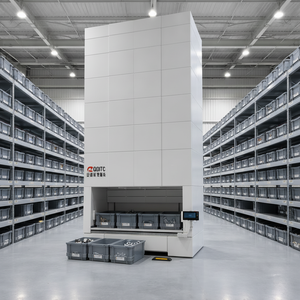
Explore our export-certified storage systems, dynamic gravity racks, automated vertical lifts, and heavy-duty industrial fabrications manufactured with strict tolerances.
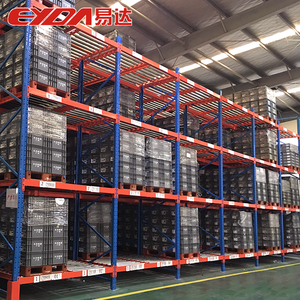

A systematic comparative analysis of volumetric density, structural tolerances, mechanical floor guidance, and high-bay intralogistics kinematics.
In modern industrial warehousing, industrial land acquisition costs and high-bay building rents demand maximum cubic utilization. Very Narrow Aisle (VNA) racking systems represent the pinnacle of static warehouse density, reducing operational aisle widths from the traditional 3,200mm–3,800mm (standard counterbalanced forklift configurations) down to 1,500mm–1,800mm. By compressing dead transit corridors and expanding vertical elevations up to 18 meters or higher, VNA architecture expands net pallet capacity by 45% to 60% within the exact same building footprint.
Unlike standard selective racking, VNA structural design operates within extreme physical tolerances. As high-lift articulated trucks or man-up turret trucks operate at heights exceeding 15 meters, any structural deviation, torsional deflection, or floor unevenness is dramatically magnified. Structural uprights must therefore be manufactured using precision continuous roll-forming lines with verified cold-rolled high-tensile steel grades (such as certified Q235B and Q355B coils) to guarantee plumb line accuracy under maximum dynamic operational loading.
To assist warehouse operations directors, 3PL general contractors, and procurement engineers in technical validation, the following table compares VNA racking against conventional selective and drive-in architectures:
| Storage Architecture | Working Aisle Width | Vertical Clear Height | Pallet Selectivity | Floor Flatness Class | MHE Guidance Required |
|---|---|---|---|---|---|
| Very Narrow Aisle (VNA) | 1,500 mm – 1,800 mm | Up to 18,000 mm | 100% Direct Access | Superflat (DIN 18202 / VDMA) | Mechanical Rail or Inductive Wire |
| Standard Selective Rack | 3,200 mm – 3,800 mm | Up to 10,000 mm | 100% Direct Access | Standard Industrial Slab | Free Steer (None Required) |
| Drive-In / Drive-Through | N/A (Lane Block Stacking) | Up to 12,000 mm | LIFO / FIFO (Batch Only) | Moderate Class | Structural Internal Floor Guides |
| Pallet Flow Gravity Rack | Loading / Unloading Ends | Up to 12,000 mm | FIFO (High SKU Throughput) | Moderate to High Class | External Guidance Only |
Operating turret trucks within a 1,600mm corridor leaves mere millimeters of side clearance between pallet profiles and vertical structural uprights. Manufacturers and structural design engineers specify two primary tracking modalities:
1. Mechanical Guide Rails: Continuous heavy-duty low-profile steel angles (such as L100x75 or L125x80 profiles) anchored rigidly to the concrete foundation slab with high-tensile expansion anchors. These rails physically confine the guide rollers of the truck, enabling high-speed travel without steering deviation.
2. Wire / Inductive Guidance: A low-frequency electric sensor wire embedded 15mm into the center of the warehouse concrete aisle. Onboard turret truck antennae track the electromagnetic field to execute automated steering corrections, eliminating steel floor guide obstructions and facilitating rapid cross-aisle transfers.
Fully vertically integrated steel processing: from automated slitting and cold-roll forming to robotic multi-axis welding and automated electrostatic powder coating lines.
Equipped with 24-station continuous rolling profiles, automated multi-head punching, and tight cold-forming tolerances to produce ultra-straight upright profiles up to 14 meters continuous length without splice welds.
We source structural Q235B and Q355B coils directly from Tier-1 national mills (Baosteel, Shougang). Every batch is verified via spectrometry, yield tensile testing, and Charpy impact toughness testing.
Beam connectors and safety locking hooks undergo automated dual-torch robotic welding. Homogeneous penetration curves eliminate micro-cracking and satisfy EN 15512 and RMI dynamic beam shear criteria.
Multi-stage automated acid pickling, phosphating, and deionized water rinsing, followed by continuous electrostatic thermosetting polyester powder coating. Salt spray corrosion endurance exceeds 500 hours.
Every customized high-bay narrow aisle rack profile is modeled using ANSYS FEA software to simulate seismic acceleration (PGA up to 0.4g), dynamic wind shear, asymmetric buckling loads, and progressive collapse scenarios.
Comprehensive knocked-down (KD) bundle export packaging with corner edge protectors, bundled container loading calculations, bilingual CAD installation drawings, and overseas engineering dispatch teams.
How supply chain executives, global procurement leaders, and logistics infrastructure planners are optimizing capex and operational efficiency.
Procurement teams are shifting away from standalone manual turret trucks toward hybrid narrow-aisle environments. Modern VNA racks are increasingly integrated with dual-drive Automated Guided Forklifts (AGFs) and Autonomous Mobile Robots (AMRs) equipped with LiDAR SLAM navigation. Racks must now feature QR code floor indexing, precision-machined beam runouts, and calibrated pallet positioning sensors to facilitate seamless robotic picking without human intervention.
Rising raw steel prices and sustainability decarbonization mandates are driving procurement engineers toward ultra-high-yield micro-alloyed steels (such as Q420 and Q460 cold-rolled coils). Through advanced cold roll-forming with multi-ribbed profiles, manufacturers can reduce raw steel wall thickness by 12% to 18% while sustaining identical or superior buckling strength and frame bending moment capacities.
Global fulfillment centers are shifting toward rapid-assembly modular boltless beam connections and pre-punched slotted uprights that easily convert into rack-supported building structures (Clad-Rack Warehouses). In cold chain environments down to -30°C, procurement contracts explicitly mandate sub-zero impact-tested steel, specialized anti-brittle zinc epoxy primers, and heated guide rail profiles.
From structural health telemetry to intelligent seismic dissipation, explore the engineering breakthroughs deployed in China’s premier manufacturing plants.
Next-generation high-bay installations are incorporating embedded Fiber Bragg Grating (FBG) strain sensors and triaxial accelerometers directly onto critical upright bases and beam connectors. This telemetry continuously measures real-time frame deflections, dynamic forklift impact shocks, and asymmetrical pallet overload. If structural deformation approaches 80% of the elastic limit, automated alerts notify the warehouse management software (WMS) to lock out the compromised aisle until inspection.
High-bay VNA racks installed in active seismic zones (PGA > 0.25g) face severe resonance risks when fully loaded. Chinese research institutes and advanced manufacturers have developed sacrificial energy-dissipating friction dampers positioned at vertical bracing nodes and baseplate anchor interfaces. During seismic ground motion, these dampers dissipate kinetic energy through controlled cyclic sliding, preventing brittle weld failures and structural progressive collapse.
Clear, engineering-backed answers addressing structural design, floor conditions, container load consolidation, and international quality certifications.